Automatic Technical Drawing Recognition
Achieve 98% automation with 99% accuracy through the perfect balance between AI power and European reliability
Discuss Your Drawing Automation
From stacks of technical drawings to smart data in seconds
Engineering companies lose an average of 2+ hours per day manually processing technical drawings. With EasyData’s AI-driven recognition, you transform this time-consuming process into an automated workflow that saves €50,000 per year for organizations processing 1000+ drawings per month.
Our Machine Learning technology automatically recognizes critical information from CAD drawings, construction plans, and technical schematics – including handwritten notes, symbols, and tables. With 25+ years of experience in document automation, we understand the challenges of engineering teams.
Stop wasting time with manual drawing analysis
Your benefit: No more errors in quotes due to misread specifications.
Core Features of Technical Drawing Recognition
🎯 Automatic Classification
Recognizes drawing types: design drawings, revision drawings, construction drawings, and installation drawings with 99% accuracy.
📊 Data Extraction
Extracts drawing author, date, version number, project codes, and all relevant metadata automatically into editable datasets.
✍️ Handwriting Recognition
ICR technology deciphers handwritten notes and revision comments that are crucial for project tracking.
🔍 Symbol Recognition
Identifies technical symbols, dimensioning, and industry-specific codes according to international and European standards.
📋 Table Processing
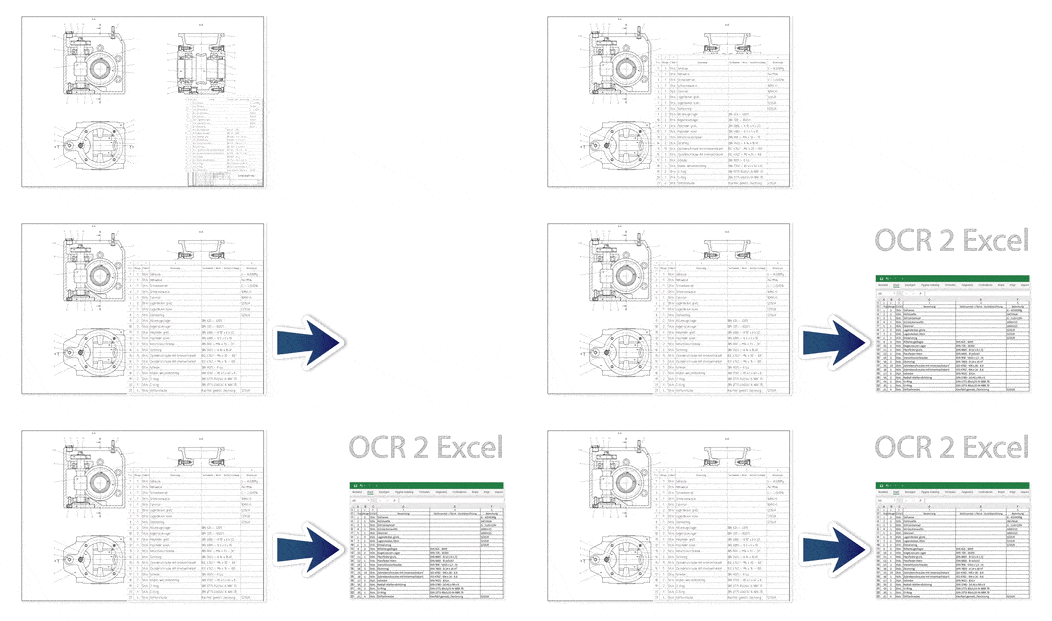
Converts complex tables and bills of materials to structured data via our Text to Excel technology.
🔒 GDPR Compliance
Our European data center ensures full GDPR compliance and European privacy legislation adherence.
Context Understanding, More Than Traditional OCR
Our technology understands the meaning of technical specifications in their context
European AI Technology Built for Data Sovereignty
Unlike American cloud solutions that are often less transparent about data handling, EasyData offers complete data sovereignty with processing entirely within the European Union. We can train our AI models on exactly your technical specifications.
Why organizations choose EasyData:
- No hidden costs: Transparent European pricing
- Local expertise: 25+ years experience with European CAD standards
- Data stays in Europe: GDPR-compliant processing guaranteed
- Flexible integration: Works with existing PLM and CAD systems

Measurable Results for Your Workflow
Case Study: From 20 Minutes to 30 Seconds Per Drawing
Before EasyData Implementation
- Engineers spent 20% of their time reading title blocks
- 20 minutes per drawing for manual data extraction
- 12% error rate in quotes due to misread specs
- 3 days production delay due to unclear specifications
- 15% missed opportunities in new projects
After EasyData Transformation
- Engineers focus 80% on real engineering work
- 30 seconds automatic drawing analysis
- <1% error rate through AI validation
- Quote turnaround of 4 hours instead of 3 days
- 35% growth in orders through automatic detection
Financial Impact – First Year
Customers report an average of 70% cost savings versus manual processing, with ROI within 6 months. Our digital transformation approach ensures seamless integration with existing work processes.
Turnkey Implementation: From Chaos to Control in 8 Weeks
EasyData’s proven implementation methodology ensures guaranteed results without IT specialists at the customer site. Our approach is based on 150+ successful implementations in the engineering sector.
Phased Implementation Roadmap
Week 1-3: Quick Setup
- Upload of historical drawings for AI training
- Configuration of specific extraction rules
- API integration for existing applications
Week 4-6: Automation
- Direct connection with incoming drawings
- Real-time processing within minutes
- Automatic quality validation
Week 7-8: Optimization
- Fine-tuning to company-specific standards
- Documentation alignment with stakeholders
- Go-live with full support
Technical Architecture
EasyData’s technical drawing recognition works via a layered AI architecture:
- Document classification: AI determines drawing type and expected layout
- Zone segmentation: Identifies relevant zones for data extraction
- Object recognition: Machine Learning datasets find specific components
- OCR and ICR processing: Extracts both typed and handwritten text
- Table analysis: Special algorithms for complex tables and bills of materials
- Quality control: AI validation ensures 99% accuracy
This modular setup means we can customize recognition to your specific drawing types and industry requirements, from civil engineering to mechanical engineering.
🎯 EasyData Implementation Guarantee
Fully working system within 8 weeks. Fixed price, fixed delivery date, guaranteed results.
Developments in Technical Drawing Recognition
The European market for automatic drawing recognition is growing rapidly. According to industry research, more than 12 percent of European companies already use AI technologies such as machine learning and pattern recognition. The global OCR market is expected to grow significantly at 14.8% per year until 2032.
The Hidden OCR Technique
Imagine: every day across Europe, thousands of technical drawings, construction plans, and CAD files are processed by smart algorithms. This raises the question, Why does this OCR application remain so invisible?
First, it’s a niche market within the broader OCR service industry. You can picture it as a hidden diamond in a mountain of coal. Where general text recognition is massively applied (think of scanning invoices and contracts), drawing recognition requires specialized expertise and a very targeted customer-focused approach.
A second cause is that few organizations publish specific data about these activities. It’s as if they want to protect their competitive advantage by keeping their successes quiet. Understandable, but somewhat frustrating for those performing these tasks.
A Growth Story Without Numbers
This creates a unique situation: a technology that companies clearly find valuable, otherwise they wouldn’t invest in it. But whose actual impact remains hidden in the shadow of general market categories. It’s like knowing there’s a party going on, but no one wants to tell you the exact location.
So sometimes there are interesting market developments that escape traditional measurement methods. It’s up to the interested reader to investigate the possibilities further themselves.
💡 Why EasyData is the European Choice
What Gets Automatically Recognized in Technical Drawings?
Bottom Right Corner (Title Block)
The bottom right corner of technical drawings contains standard information that can be automatically read:
- Project name and description
- Company stamp and draftsman details
- Drawing and project number
- Scale and format
- Date and status (concept, final, revision)
- Material specifications
Technical Components
Modern recognition software can also identify components and details in the drawing itself:
- Dimensions and tolerances
- Symbols and notations
- Handwritten annotations
- Tables with specifications
- Material designations
- GD&T symbols and surface roughness
🔍 Advanced Recognition Capabilities
System Integration
Connection with existing applications for automatic data synchronization and database reading.
ERP System Export
Automatic export to quality management systems and Document Management Systems.
Machine Learning Training
Self-correcting mechanisms that learn from your specific drawing standards for improved accuracy.
Pattern Recognition AI
Identifies specific drawing components and automatically classifies drawing types (design, specification, working drawing).
Frequently Asked Questions
Does recognition also work with old, scanned drawings?
Yes, our AI technology is specially trained on various quality drawings. We first perform intelligent image enhancement, after which our OCR engine can process even older, lower-resolution drawings with high accuracy.
How quickly can EasyData be integrated into our existing system?
Implementation takes an average of 4-8 weeks, depending on your system complexity. We offer API connections for all common PLM, CAD, and document management systems.
What happens to our sensitive technical data?
All processing takes place in our European data center according to GDPR guidelines. We maintain strict NDAs and offer on-premise installations for extra sensitive projects. Your data never leaves the European Union.
Can you recognize our specific symbols and notations?
Absolutely. We train customized models on your specific drawing standards and symbols. With sufficient examples, we achieve full recognition of your unique notations and company standards within 2-4 weeks.
What are the costs for technical drawing recognition?
Our pricing is transparent and based on processing volume. Organizations pay no hidden costs or per-user license fees. We offer flexible models from pay-per-use to fixed monthly subscriptions.
How accurate is the recognition of handwritten notes?
Our ICR (Intelligent Character Recognition) technology achieves 95%+ accuracy with handwriting in multiple languages. The system learns from your specific handwriting and automatically improves accuracy over time.
🖊 About the Author

Ready to Move from Manual Drawing Processing to Smart Automation?
Our AI-driven recognition delivers 98% automation, 6+ hours daily time savings, and €690K cost savings per year. Join engineering teams that have already completed their digital transformation.
💶 Guaranteed Results with European Technology
✓ GDPR-compliant processing in European data centers
✓ 25+ years expertise in technical document automation
✓ No vendor lock-in, transparent pricing
✓ We’re happy to provide a free Proof of Concept