Data Science Since 1999
European Data Center
25 years expertise in OCR, AI and automation. GDPR-compliant. Mathematical developers.
Own secure European data center.

Understanding algorithms is specialization.”
1999: while others worried about the millennium bug, we started document automation in Apeldoorn, Netherlands. 25 years later: 200+ projects, offices in the Netherlands and Armenia, our own European data center. What began as a local software company has grown into a data science specialist with mathematical expertise.
Not stringing APIs together, but self-developed algorithms. Not American cloud, but European data center. Not theoretical consultancy, but practical implementation. This distinguishes us in a market full of marketing talk.
Started 1999: why then and not later?
Timing was strategic. Early 2000s: companies were digitalizing massively, but tools for intelligent data processing were lacking. OCR technology existed but was unaffordable for SMEs. We made document recognition accessible through focus on practical implementation and honest pricing.
EasySeparate, our first product, emerged from concrete customer demand: “Can you automatically extract data from this stack of invoices?” That became our specialization: from paper documents to structured data. No fancy marketing, just working software.
Focus was immediately on mathematical fundamentals. Text recognition isn’t a simple programming task but requires understanding of pattern recognition and machine learning. Our developers have university backgrounds in mathematics – essential for algorithm development.
That approach pays off. Where others depend on external AI services, we develop our own models. This provides control, customization and independence. Our revenue model is built on sustainable partnerships, not vendor lock-in.
25 years later the core remains the same: translating technical excellence into practical solutions. From local start-up to European specialist with our own R&D capabilities.
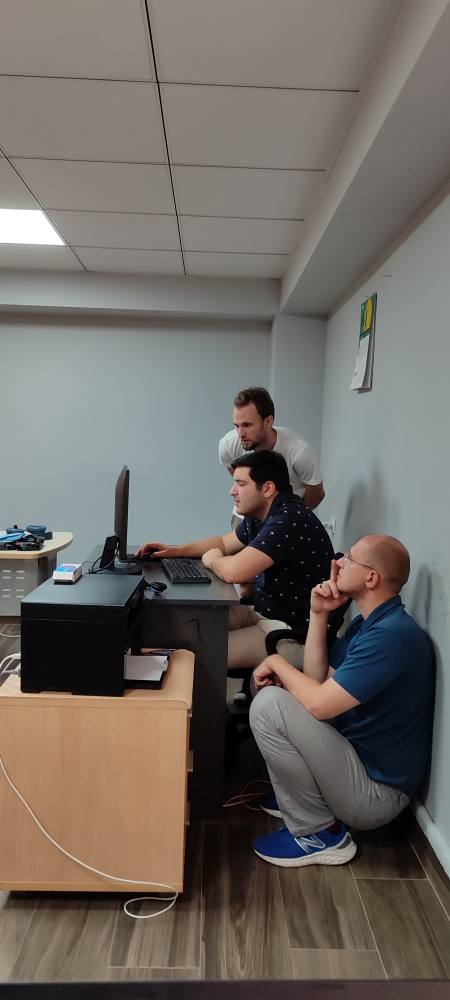
Development team: mathematical expertise meets software engineering
Market situation 1999: gap between supply and demand
Digitalization accelerated, but practical automation tools were lacking. Big tech companies focused on hardware and basic infrastructure. The real challenge – interpreting unstructured data – received little attention. Our data-driven approach filled that gap.
Hybrid strategy: open source + proprietary development
We combine open source frameworks with proprietary innovation. Advantage: flexibility of open technology, reliability of own code. No religious debates about open vs closed – pragmatically choosing what works.
International expansion: why Yerevan?
2022: strategic choice for an office in Armenia. Reason: access to mathematical talent. Armenia has a strong tradition in exact sciences since the Soviet period. Yerevan State University produces excellently trained software engineers and data scientists.
This makes a difference in AI development. Programming Python is one thing, understanding and optimizing mathematical models is specialization. Our Armenian developers bring that depth – essential for self-developed algorithms versus standard API calls.
Mathematical expertise: why this is critical
Data science revolves around statistics, linear algebra, calculus. Without mathematical foundation you cannot develop reliable algorithms. The difference between us and consultancy firms: we actually build machine learning models, not PowerPoint decks about AI potential.
Data sources
- CBS Open Data Portal – Official Dutch statistics
- CBS Digitalization and Knowledge Economy 2024 – ICT sector development
- CBS AI Monitor 2024 – AI adoption figures
- Eurostat Science & Technology – European comparison data
*Data for informational purposes. No guarantees on external sources.
Data visualization: translating complexity into insight
Raw data is useless without interpretation. Our visualization experts build dashboards that translate technical complexity into business insights. Tools: Grafana, proprietary interfaces, practical reports.
Cloud strategy: European data center, own management
Cloud computing offered opportunity for cost savings via American providers. We chose differently: our own cloud infrastructure in a European data center. Reason: data sovereignty. European data under European law, without CLOUD Act risks.
Our cloud follows CIS Benchmarks for security. This is not a marketing claim but an implementation requirement. Result: full GDPR compliance, transparent data processing, no vendor lock-in with American tech giants.
Intellectual property: protecting European innovation
Self-developed algorithms constitute intellectual property under Dutch law. Important in an era where data is competitive advantage. For customers this means: certainty about compliance, continuity and control over their own innovations.
Automation of manual processes
Many organizations still process data manually. Our automation eliminates repetitive tasks: invoice recognition, document classification, data extraction. Focus on ROI, not technology for technology’s sake.
Lessons learned from 25 years of practice
Most important insight: technology is a means, not a goal. The best algorithms are worthless without practical applicability. That’s why, for example, Excel integrations – not because Excel is cutting-edge, but because it’s used. Usability > innovation for innovation’s sake.
Partnership model: why this is more effective
We don’t develop all-in-one platforms but integrate with specialized partners. Reason: depth > breadth. Partners know their industry, we deliver technical excellence. Result: better solutions than one-size-fits-all software.
ABBYY partnership: 25+ years of collaboration
One of Europe’s longest-running ABBYY partnerships. We combine their OCR technology with our own innovations. No blind dependency but strategic collaboration that strengthens both parties.
Future: where we continue to invest
Core principles remain constant: technical depth, practical applicability, European data sovereignty. AI continues to democratize – our role remains translating complexity into usable solutions.
Focus coming years: self-developed machine learning models for specific use cases, further optimization of document processing pipelines, expansion of European data center capacity. Not because of hype but because of concrete customer demand.
Whether you’re a multinational with process optimization challenges or an SME taking first automation steps: our expertise is at your disposal. No marketing talk but working code. That’s our story in one sentence.
Frequently asked questions about our approach
Data sovereignty. Our cloud infrastructure runs in European data centers under European law. This means:
Full GDPR compliance: European data remains under European legislation. No CLOUD Act risks where American authorities can demand access to data on servers of American companies, regardless of where they’re physically located.
Control over your own data: With American cloud providers, American law applies. We guarantee: European data stays European, with transparent processing under verifiable compliance.
Operational certainty: No dependency on foreign providers with unpredictable policy changes. Own data center = own control = predictable business continuity.
*GDPR compliance based on current European legislation, specific requirements may vary per sector.
Our developers have university backgrounds in mathematics and computer science. This makes the difference between:
Calling APIs vs developing algorithms: Anyone can use OpenAI’s API. We build our own machine learning models, optimized for specific use cases. This requires understanding of statistics, linear algebra, calculus.
Practical impact: We optimize algorithms for speed and accuracy, build custom neural networks for document classification, and can explain exactly why a model makes certain decisions – no black box.
R&D capability: We don’t just follow trends, we contribute to state-of-the-art. Publishing papers, improving algorithms, innovation from understanding not from marketing.
Strategic choice for access to mathematical talent. Facts:
Technological tradition: Armenia was a center for computer science during the Soviet period. That expertise remains: Yerevan State University annually produces excellently trained software engineers and data scientists.
Talent gap solution: Western Europe has a shortage of qualified data scientists with mathematical backgrounds. Armenia has a surplus of highly educated professionals – economic arbitrage that benefits both parties.
Cost efficiency without quality loss: Lower labor costs with equivalent education level. This translates to competitive pricing for customers without compromising technical quality.
*Team composition dependent on project requirements and available expertise.
We develop software, not PowerPoints. Concrete differences:
98% remote workforce: Minimal overhead, maximum efficiency. No expensive office locations, no unnecessary management layers. Cost savings go to R&D and competitive pricing.
Own development teams: Direct control over code quality, short lines for adjustments, no dependency on external contractors. This means faster iterations and better customization.
From concept to code: We combine technical depth with practical implementation. No strategic advice without execution – we actually build working software.
Partnership model: Long-term relationships, not project-and-go. We grow with customers, continuously optimize, and share expertise without consultant rates.
25+ years specialization. Concrete track record:
ABBYY partnership since 1999: One of Europe’s longest-running partnerships. We know OCR technology inside-out, from basic text recognition to complex handwriting recognition.
200+ implementations: Experience at municipalities (civil registry, permits), accountants (invoice processing), companies (contract management, mailroom automation). Practical knowledge from diverse sectors.
From simple to complex: Simple invoice recognition to multi-document workflows with AI classification. We realistically estimate what’s achievable and what’s not – no overselling of capabilities.
*Project results dependent on document quality, volume and specific requirements.
Practical benefits without hype:
For SMEs: Process efficiency through automation of repetitive tasks. Better decision-making via data analysis. Predictive models for inventory management and customer behavior. Scale advantages without proportional personnel growth.
For public sector: Faster processing of applications (permits, subsidies). Fraud detection via pattern recognition. Optimization of resource allocation. More transparent decision-making via data-backed reasoning.
ROI examples: Invoice processing from 15 minutes to 2 minutes per document. Error rate from 8% to <1%. Permit application turnaround from 4 weeks to 10 days. These are concrete figures from existing implementations.
*Results based on measured KPIs at existing customers, individual results vary.
Interested in practical automation?
No marketing talk but working solutions. We start with an honest conversation about what’s achievable for your situation. Cloud, on-premise, or hybrid – we advise what fits, not what sells most.
Transparent, technical, to-the-point
European data center. 25+ years expertise. Own AI models.
That’s how partnership with EasyData works.
*Implementation timelines dependent on project scope and organization-specific factors.
⭐ Author